
 +86-571-88842852  
  oceanindustry@vip.163.com 
You are here: Home » News and Events » Gear Transmission: How Small Gears Rotate The Big World

Gear Transmission: How Small Gears Rotate The Big World

Views: 2     Author: Site Editor     Publish Time: 2025-07-29      Origin: Site
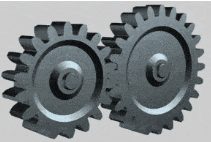
1.1 Core Components

1.2 Meshing Principle
a) Formation of Involute Tooth Profile
  • The meshing line is a straight line: The trajectory of the meshing point of the two gears is a fixed straight line.

  • Constant transmission ratio: Ensures the smoothness of transmission.

  • Divisibility of center distance: Changes in center distance do not affect the transmission ratio.

  • Constant force direction: The pressure angle remains unchanged during meshing.

To keep the transmission ratio of a pair of gears constant, the basic law of tooth profile meshing must be satisfied:
When the tooth profiles of two gears are in contact at any position, the common normal line through the contact point must pass through the pitch point P (i.e., the tangent point of the two pitch circles);
The involute tooth profile fully satisfies this law, thus ensuring a constant transmission ratio.

1.3 Basic Characteristics of Gear Transmission
  • Gear Transmission Ratio Relationship


    The transmission ratio (i) is the ratio of the rotational speed of the driving wheel (n₁) to the rotational speed of the driven wheel (n₂), and it is also equal to the ratio of the number of teeth of the driven wheel (z₂) to the number of teeth of the driving wheel (z₁), that is:
    i = n₁/n₂ = z₂/z₁
    For example, if the number of teeth of the driving wheel is 20 and that of the driven wheel is 40, the transmission ratio i = 2, which means that when the driving wheel rotates 2 circles, the driven wheel rotates 1 circle.

    • Pitch circle diameter: d = m × z

    • Addendum circle diameter: da = d + 2ha = m(z + 2ha*)

    • Dedendum circle diameter: df = d - 2hf = m(z - 2ha* - 2c*)

    • Base circle diameter: db = d × cosα

    • Standard center distance: a = (d1 + d2)/2 = m(z1 + z2)/2

    • Module (m): The basic dimension parameter of a gear, in mm. The larger the module, the larger the gear size.

    • Number of teeth (z): The total number of teeth on the gear.

    • Pressure angle (α): The standard value is 20°, which is an important parameter for the direction of the gear transmission force.

    • Addendum coefficient (ha*): Usually 1.

    • Clearance coefficient (c*): Usually 0.25.

    The direction of rotation of externally meshed gears (gears that are convex outward and mesh with each other) is opposite; the direction of rotation of internally meshed gears (one gear meshes inside another gear) is the same.


    • 2.5 Analysis of Meshing Process

      In gear transmission, the driving gear exerts a "circumferential force" on the driven gear to push the driven gear to rotate. At the same time, there are also "radial force" (perpendicular to the gear axis) and "axial force" (parallel to the gear axis, existing only in non-straight bevel gears such as helical gears and bevel gears) between the two gears. Spur gears have no axial force and transmit more smoothly; although helical gears have axial force due to the inclination of the tooth surface, their meshing is tighter and their load-carrying capacity is stronger.

      The main acting force in gear transmission is the normal force Fn along the meshing line direction, which can be decomposed into:

      • Engagement stage: The addendum of the driven gear starts to contact with the dedendum of the driving gear.

      • Normal meshing stage: The two tooth surfaces are in continuous contact on the meshing line.

      • Disengagement stage: The addendum of the driving gear is separated from the dedendum of the driven gear.


    • Gear Transmission Lubrication and Maintenance


      Development Trends of Gear Transmission


      • As a basic component of mechanical transmission, the technical development of gear transmission directly affects the progress of the entire machinery industry. Gear transmission is developing towards higher precision, higher strength, longer service life and lower noise.

      • Tooth surface pitting: Improve tooth surface hardness and lubrication conditions.

      • Gear tooth breakage: Increase the module and improve material toughness.

      • Tooth surface wear: Improve lubrication conditions and increase tooth surface hardness.

      • Tooth surface gluing: Use lubricating oil with strong anti-gluing ability.

      • Oil immersion lubrication: Suitable for gears with circumferential speed v ≤ 12m/s.

      • Oil injection lubrication: Suitable for high-speed gears with v > 12m/s.

      • Grease lubrication: Used in low-speed, light-load occasions or where it is inconvenient to use thin oil lubrication.


      Category List

      Make Business Easier

      We offer not only products, but also our after-sales service.
      View More >

      Quick Links

      Contact Us

      ​Tel:  +86-571-88842852
      Fax: +86-571-88844378
      Email: oceanindustry@vip.163.com
      oceanindustry011@hzoic.com
      Add: 4th Floor, Block 2, Qianjiang Century Industrial Park, 2327 Hongning Road,Ningwei Town,Hangzhou, China
      Leave a Message
      ​Copyright © Hangzhou Ocean Industry co.,Ltd. All Rights Reserved. Site Map