Hot Keywords:
- All
- Product Name
- Product Keyword
- Product Model
- Product Summary
- Product Description
- Multi Field Search
Views: 0 Author: Site Editor Publish Time: 2026-01-23 Origin: Site
304 stainless steel exhibits excellent rust resistance in dry and clean atmospheres but tends to rust quickly in coastal areas with salt-rich sea mist.
316 stainless steel, on the other hand, performs well in such marine environments due to its enhanced corrosion resistance.
Electrochemical corrosion: Dust or foreign metal particles on the surface form a micro-battery with stainless steel via condensed water in humid air, triggering electrochemical reactions that damage the film.
Organic acid corrosion: Organic juices adhering to the surface react with water and oxygen to form organic acids, which corrode the metal over time.
Localized corrosion: Exposure to acids, alkalis, or salts (e.g., alkaline water or lime water from wall decoration).
Chemical corrosion: In polluted air containing sulfides, carbon monoxide, or nitrogen oxides, condensed water forms sulfuric acid, nitric acid, or acetic acid droplets that corrode the surface.
Regularly clean and wipe decorative stainless steel surfaces to remove attachments and eliminate external corrosion triggers.
Use 316 stainless steel in coastal areas to resist seawater corrosion.
Select products from reputable manufacturers to ensure chemical compositions meet national standards (e.g., 304 grade requirements).
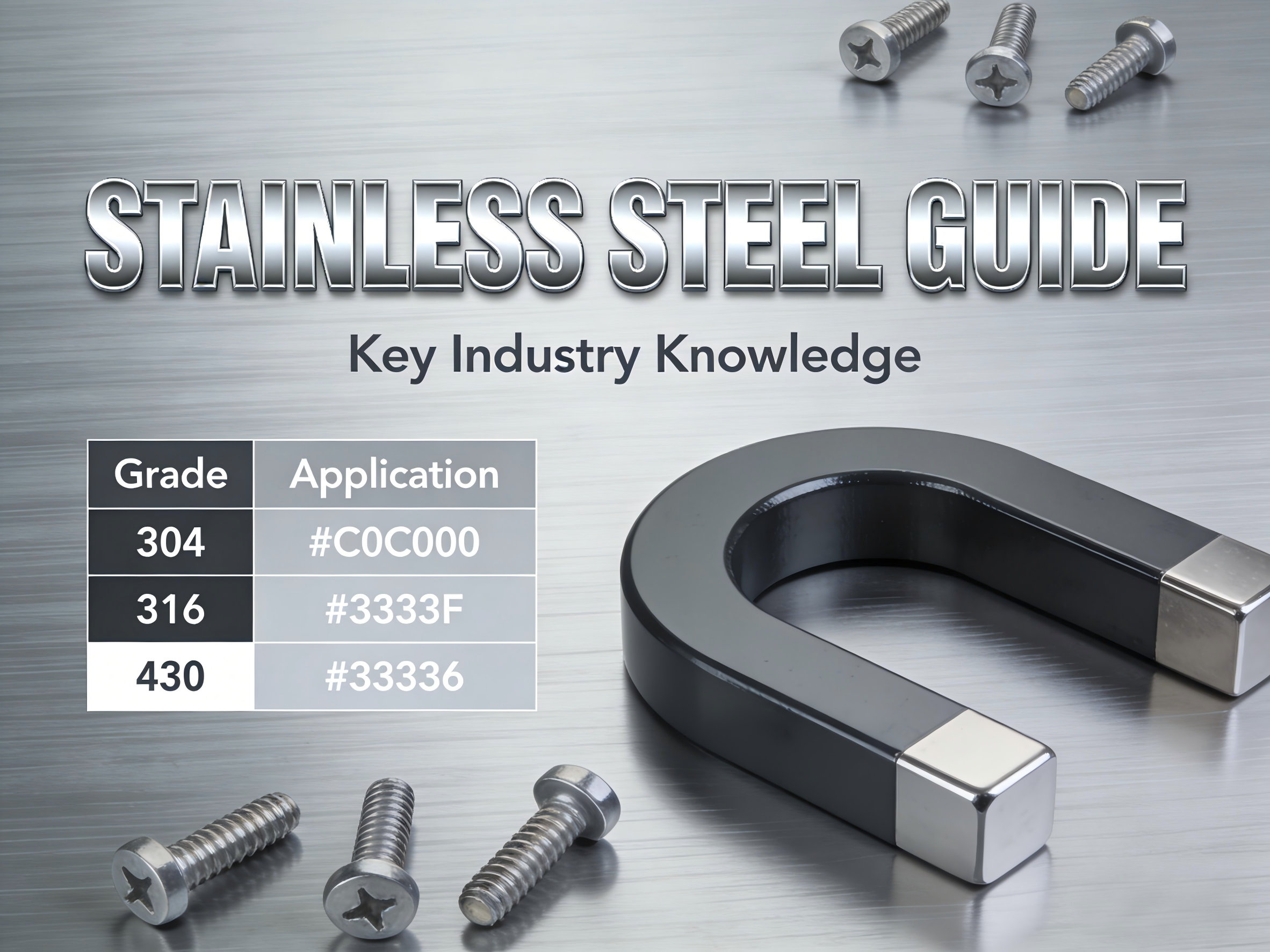
| Category | Common Grades | Magnetism |
|---|---|---|
| Austenitic | 201, 202, 301, 304, 316 | Non-magnetic or weakly magnetic |
| Martensitic/Ferritic | 430, 420, 410 | Magnetic |
Segregation during smelting or improper heat treatment may result in small amounts of martensitic or ferritic structures in austenitic 304 stainless steel, leading to weak magnetism.
Cold working (e.g., bending, forming) converts part of the austenitic structure to martensite. Greater deformation (e.g., in rectangular tubes compared to circular tubes) increases magnetism.
Weakly magnetic or non-magnetic stainless steel is likely 304 or 316 (austenitic grades).
Strong magnetism, similar to carbon steel, indicates it is not 304 (likely martensitic/ferritic grades like 430).
Cost-effective alternative to 300 series.
Suitable for general decorative and low-corrosion environments.
<