Hot Keywords:
- All
- Product Name
- Product Keyword
- Product Model
- Product Summary
- Product Description
- Multi Field Search
Views: 0 Author: Site Editor Publish Time: 2026-02-05 Origin: Site
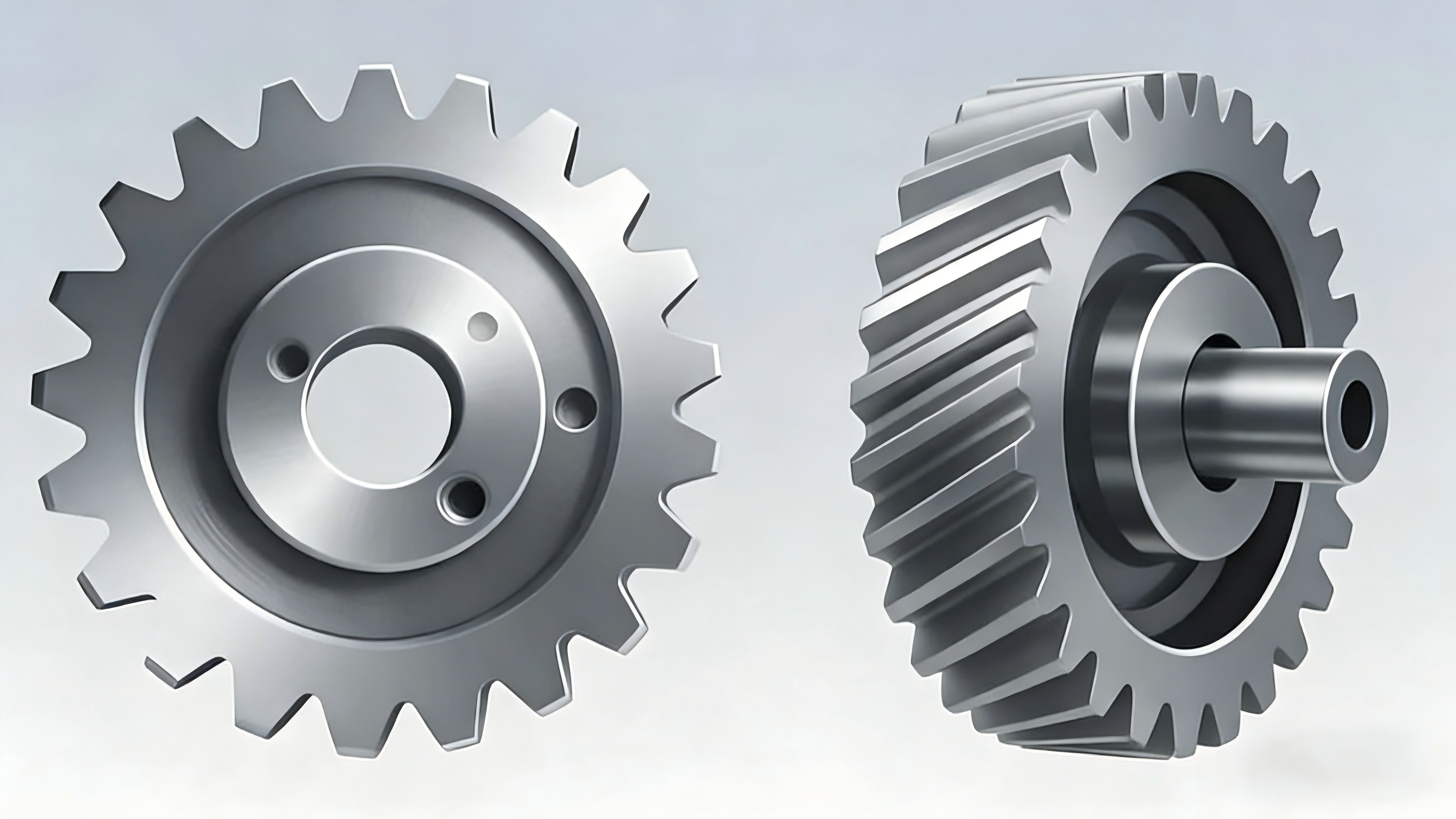
Tooth Profile & Processing: The tooth outline appears as a straight line (involute on the end face), making 3D modeling in CAD software intuitive (often completed via extrusion commands). Manufacturing relies on mature processes like form milling cutters and gear shapers, resulting in low costs.
Meshing Characteristics: Teeth make sudden full-face contact and disengagement, with the contact line parallel to the axis at any moment.
No axial force, simplifying bearing selection and support structure design.
Simple manufacturing and low cost, ideal for single-piece or small-batch production.
High transmission efficiency, typically ranging from 98% to 99.5% under ideal conditions.
Easy assembly, insensitive to minor center distance variations.
High noise and vibration due to sudden meshing impact, unsuitable for high-speed operation.
Low load-carrying capacity: Only one (or less than one) pair of teeth meshes at a time, leading to high load per tooth width and lower contact/bending strength compared to helical gears.
Low contact ratio (1.4-1.6, usually less than 2), resulting in poor transmission stability.
Tooth Profile & Processing: The tooth profile is a helical involute surface, requiring "helical sweep" functions for CAD modeling. Manufacturing demands specialized hobbing or shaping machines and tools matching the helix angle, leading to higher complexity and cost.
Meshing Characteristics: Progressive meshing—teeth engage from one end, gradually extend to the full tooth width, and disengage smoothly, with diagonal contact lines and continuous meshing.
Smooth operation and low noise: Progressive meshing minimizes impact and vibration, making it suitable for high-speed and heavy-load applications.
High load-carrying capacity: Longer actual contact line reduces unit area pressure (high contact strength), and the inclined tooth root increases equivalent thickness (high bending strength).
High contact ratio (greater than 2, even 3-4), achieved by combining transverse and axial contact ratios, ensuring multiple tooth pairs mesh simultaneously for uniform load distribution.
Generates axial force (Fα) due to the helix angle, requiring thrust-bearing support (e.g., angular contact ball bearings, tapered roller bearings), increasing structural complexity and cost.
Complex manufacturing and higher cost, needing precision machinery and specialized tools.
Slightly lower efficiency (96%-98.5%) than spur gears due to increased tooth surface sliding friction.
| Characteristics | Spur Gears | Helical Gears |
|---|---|---|
| Tooth Design | Tooth lines parallel to the axis | Helical tooth lines with a helix angle relative to the axis |
| Meshing Method | Sudden contact and disengagement | Progressive, smooth contact and disengagement |
| Noise & Vibration | High, unsuitable for high speed | Low, ideal for high speed |
| Load-Carrying Capacity | Low | High (superior contact and bending strength) |
| Axial Force | None | Exists, requiring additional bearing support |
| Transmission Efficiency | High (98%-99.5%) | Slightly lower (96%-98.5%) |
| Manufacturing Cost | Low | Higher |
| Contact Ratio | Low (1.4-1.6) | High (>2, even 3-4) |